
“The sounds are codes. Residents know the different meanings of the sounds: every type of food or drink has its own sound.”
Now in its third year, the FluxusMuseum Prize for Experimental Video gathers eleven artists and collectives from a field of over 600 international applications, works chosen for their resistance to easy categorisation, their originality, visual rigour, and an uncompromising approach to the form. Installed across the old marble factory by Parikia’s yacht harbour, the exhibition runs until the end of September, with prize winners announced in mid-September. Ahead of the announcement, we catch up with each of the eleven shortlisted artists and collectives.
Among this year's shortlisted artists is Su Tomesen, whose multichannel video installations document itinerant street vendors and micro-economies across Yogyakarta and beyond, thematising human ingenuity and small entrepreneurship outside the Western world.
Could you describe your work featuring in the Prize, and how it sits in relation to your practice more broadly?
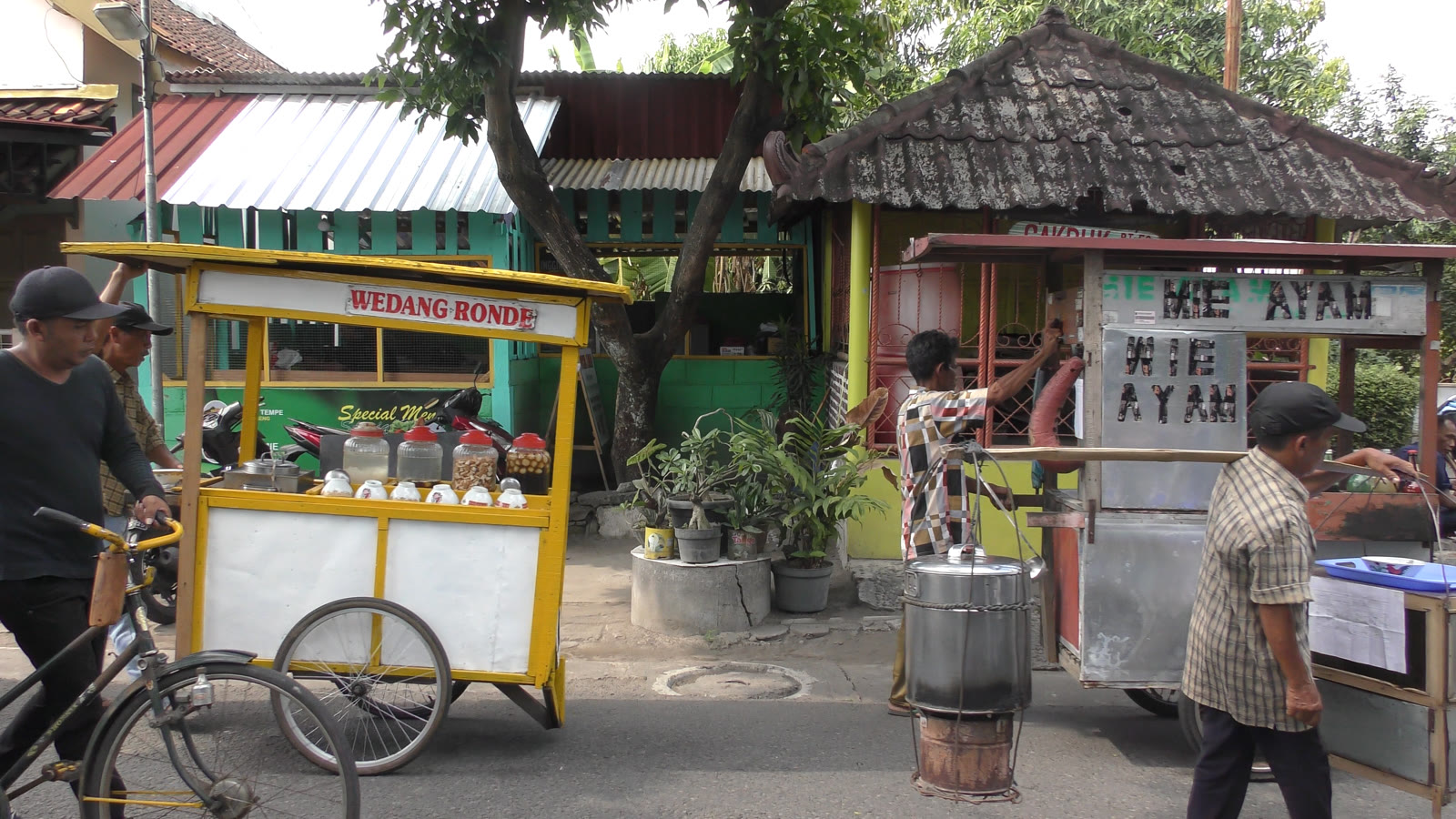
ST: "Keliling (Around)' is a three channel video installation about the phenomenon of itinerant street vending of food and drinks in the Javanese city Yogyakarta in Indonesia. To stand out while going around with their carts, these vendors make rhythmic sounds with simple 'instruments': spoon on glass, stick on bamboo, the sound of steam, an mp3 etc. The sounds are codes. Residents know the different meanings of the sounds: every type of food or drink has its own sound. When being in Yogyakarta for the first time in 2011 I was fascinated by this phenomenon, which appeared to be typical for Javanses sellers.
The video installation combines footage from 2012 until 2025 with that of the performance 'Parade', featuring 13 itinerant street vendors (pedagang keliling). The performance took place in October 2025 in the south of Yogyakarta. The vendors played a music composition - that reminds of Indonesian gamelan music and which I wrote with Dutch-Indonesian composer Sinta Wullur - while walking a few streets with their carts (gerobak).
In my films, installations and photography I focus on the beauty of ingenuity and on small entrepreneurs, especially outside the Western world. In my work I thematize the human ability to inventively take control of the urban environment. My oeuvre reads as a visual plea for a world in which life develops organically, and provides a commentary on the over-regulated West. I have translated the subject of micro-economy into a series of works. The most extensive project is the four channel video installation 'Street Vendors: Medellín, Tirana, Johannesburg, Yogyakarta' (2018), which started in Yogyakarta where I live and work part of the year since 2011.
What is your relationship to the moving image as a medium; when did it enter your practice, and what does it let you do that other mediums don't?
ST: After having worked with photography I turned to video in 1997 and worked for several television programs, directing, researching, camera, sound, editing. I also worked as a camera journalist for MTV. From 2003 to 2005 I attended the Fine Arts program at the Sandberg Institute in Amsterdam, the Master of the Rietveld Academy, focussing on video, installation and performance, and graduated in 2007. I have always stuck to time based arts: mostly video (installations), sometimes performance and audio installations. The dimension of time to be experienced is an important part of the audience being able to immerse themselves.
Are there artists, filmmakers, or traditions outside of art you feel in dialogue with here?
ST: Yes, I feel very related to the body of work of the Belgian artist Francis Alÿs, who lives and works in Mexico City. He blends performance and video - but also painting - to explore anthropology and geopolitics. His work is engaged, critical and political. My work consists of videos, photographs and installations informed by my travels and my background as a historian and television director. My art works evolve from researching local circumstances and observing situations.
His series 'Children's Games' document the ingenuity of youth play across diverse social and conflict-ridden landscapes in the world. The films were exhibited at the 59th Venice Biennale, as well as at EYE Filmmuseum in Amsterdam. There I had the opportunity to meet the artist and speaking about 'Street Vendors: Medellín, Tirana, Johannesburg, Yogyakarta', a cross-cultural documentation just like 'Children's Games'.
Some people use "experimental" to mean formally unconventional, others to mean something closer to research or inquiry. Which is closer to how you're using video here?
ST: Often I realise multichannel video installations: in that way the form of the work is an experimental one, although it is less and less unconventional these days. Since 2005 until now I realised two to eight channel video installations. Editing them is like doing mathematics, it is focusing on variuos screens and sounds at a time, and specific frames, at the flow of the whole. Research and inquiry though are also definitely part of my artistic practice since most of my work is documentary based.
What would you like visitors to experience when spending time with your work?
ST: I hope my immersive videos - and installations - enchant, amaze, immerse the audiences. As a creator, I also like to be present at exhibitions, screenings and presentations. Meeting the audience, speaking about the context of the work and its origins, and sparking thought is an important part of my work. Audiences in the West get to think about their privileges for example.
What has the support from FluxusMuseum made possible, for this piece specifically or for your practice more broadly?
ST: After having had funding from Mondriaan Fonds and Marinus Plantema Foundation to realize the performance 'Parade' in 2025 - which footage is part of 'Keliling' - I was looking for financial support to realise 'Keliling' in the beginning of 2026. The support from FluxusMuseum was the best timing: with their budget I had the freedom to hire people to help with editing, color grading and sound mixing. Next to that I was delighted to hear the work was commissioned by the Museum and became one of the finalists for the FluxusMuseum Prize for Experimental Video 2026. The external validation of being nominated is boosting my practice. Efcharisto!
What else are you working on at the moment?
ST: After visiting the FluxusMuseum at Paros in Greece in July 2026 I will send in the video installation 'Keliling' to International Film Festival Rotterdam 2027 for the Premiere in the Netherlands. There I would like to present a version with 5.1 surround sound. This version I also aim to exhibit in Yogyakarta, Indonesia. With the local producers of 'Parade' and my contacts there we will find a suitable exhibition space.
Next to launching 'Keliling' I am exhibiting existing work in various shows in the netherlands and editing a two channel installation together with performance artist Lisette Ros in Amsterdam. In my studio at Zeeburgerdijk Artists' Studios in Amsetrdam I also run project space 30m3__ and curate interventions, experiments and collaborations with fellow artists. 30m3__ is a display of my art practice focusing on the encounter with the other, co-creation and interaction with public space.

Su Tomesen concentrates on the inexhaustible potential of everyday materials, ingenuity in public space and informal economies.