
← Features · Prize for Experimental Video 2026 · In conversation
In conversation with
Natasha Cantwell
“There is beauty within the tension that we can learn to enjoy.”
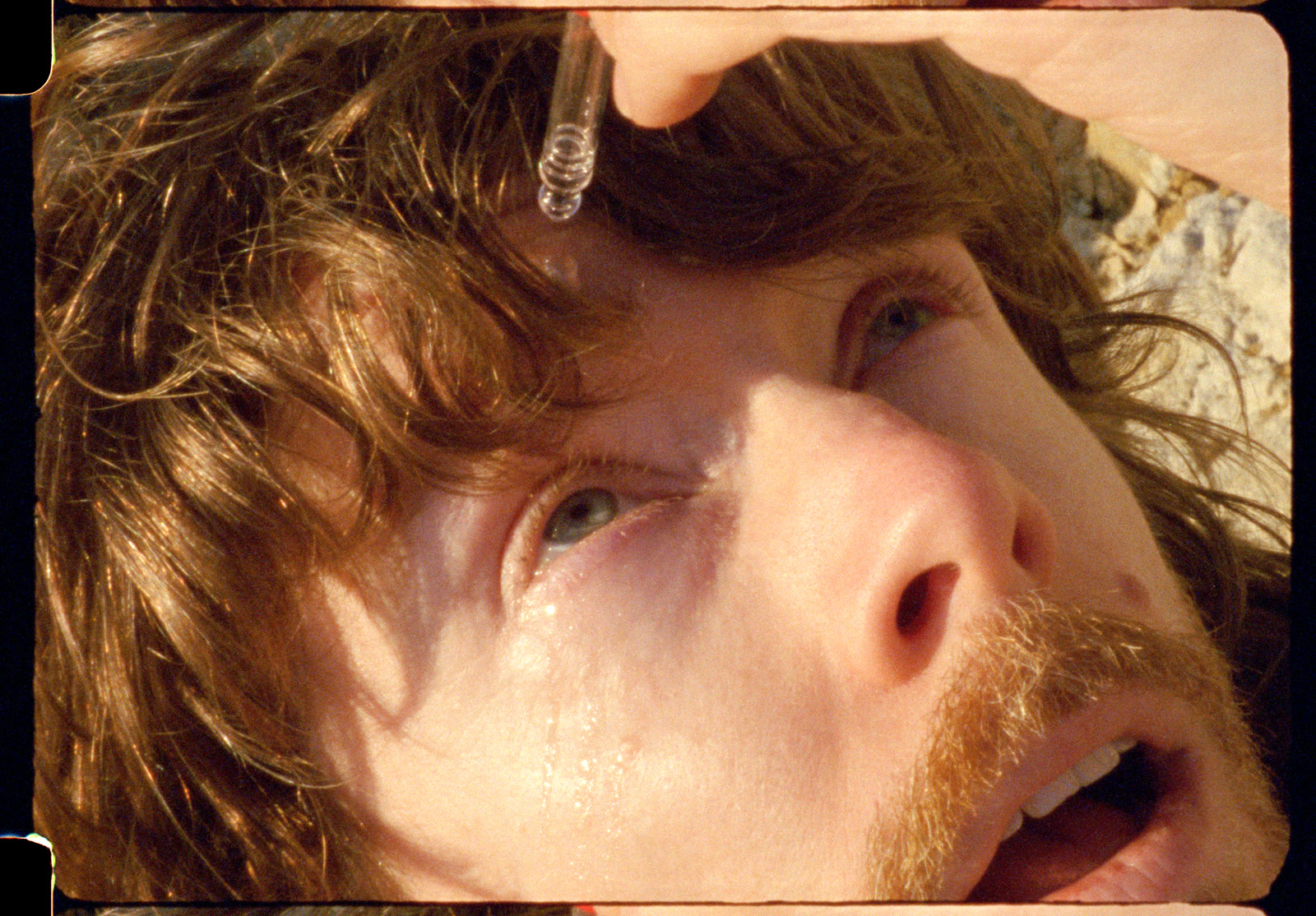
Now in its third year, the FluxusMuseum Prize for Experimental Video gathers eleven artists and collectives from a field of over 600 international applications, works chosen for their resistance to easy categorisation, their originality, visual rigour, and an uncompromising approach to the form. Installed across the old marble factory by Parikia’s yacht harbour, the exhibition runs until the end of September, with prize winners announced in mid-September. Ahead of the announcement, we catch up with each of the eleven shortlisted artists and collectives.
Among this year's shortlisted artists is Natasha Cantwell, whose 16mm film practice draws on coastal folklore to explore the uneasy relationship between human presence and the natural world.
Could you describe your work featuring in the Prize, and how it sits in relation to your practice more broadly?
NC: "The Bluff" draws from the rich tradition of coastal folklore to explore the uneasy relationship between human presence and the natural world. Our contemporary disconnect from nature is one of the overarching themes of my practice. I have such genuine feelings of awe in the wilderness, but it doesn't take long for me to start yearning for the city and the comfort of being hemmed in by skyscrapers.
I'm interested in the folk beliefs that underpinned people's relationship with nature before the mass exodus to the cities, and how the strength of the beliefs has slowly eroded over time. I remember my grandparents telling me folk stories as if they were real, but as a city child, I understood that they couldn't possibly be.
What is your relationship to the moving image as a medium; when did it enter your practice, and what does it let you do that other mediums don't?
NC: I started out as a photographer, and when I picked up a 16mm Bolex camera in 2012, I was more drawn to the grain and colours of the Vision3 film stock, than the opportunity for capturing movement. But with each film I make I've slowly embraced more of the possibilities, most recently becoming obsessed with soundtrack creation. I still love the succinctness of a single photographic shot, but with moving image there is so much scope for emotion and world-building.
Are there artists, filmmakers, or traditions outside of art you feel in dialogue with here?
NC: I watched Joanna Hogg's "The Eternal Daughter" at a film festival in 2023, not knowing anything at the time about the filmmaker's practice. I kept expecting it to explode into supernatural horror but instead the film resolved itself with the character's quiet acceptance. What resonated with me was the idea that the world can be terrifying, but there is beauty within the tension that we can learn to enjoy.
With "The Bluff", the imagery holds an unresolved sense of foreboding, but the soundtrack carries the emotional arc. It opens with an uncomfortable, arrhythmic track full of ugly chords, and ends on something more harmonious and satisfying.
Some people use "experimental" to mean formally unconventional, others to mean something closer to research or inquiry. Which is closer to how you're using video here?
NC: I see my work as inquiry, in terms of concepts, but also in terms of filmmaking. Every shoot still feels like a learning experience and the possibilities keep expanding with every detail I chase down.
What would you like visitors to experience when spending time with your work?
NC: I aim to make work that makes people 'feel', rather than respond on a purely intellectual level. What they feel will be personal to them, though. I hope that it engages with people across different generations, cultures and maybe even with those who don't usually enjoy video art.
What has the support from FluxusMuseum made possible, for this piece specifically or for your practice more broadly?
NC: I have been procrastinating over this piece for so many years, as I knew it would be difficult taking all of my 16mm film gear to a windy and crowded beach. I probably would have kept putting it off, but receiving the funding and the tight deadline forced me to just get on with it! I often default to shooting in parks and gardens, so it was amazing to have this entirely new landscape, of coastline and limestone cliffs, to be inspired by. And even though shooting involved protecting my camera from kids throwing rocks, and thinking I'd given my actor hyperthermia, it has encouraged me to continue trying out different environments as locations.
What else are you working on at the moment?
NC: I'm exploring how to bring more immersiveness into my work, and I'm currently developing an installation that uses the analogue hologram technique of 'Pepper's ghost' to enable people to interact with a marionette-controlled spider crab.

Natasha Cantwell is a New Zealand artist whose work openly embraces awkwardness and the absurdity of human behaviour. Her practice explores the tension between the visible and the unseen, and the possibility of rebuilding a connection to the natural world from a position of fractured understanding. She draws from the uneasiness of performance art and b-grade horror cinema.