
“Video also allows me to think of the archive as something active rather than historical, a living system that continues to observe, collect, and circulate information.”
Now in its third year, the FluxusMuseum Prize for Experimental Video gathers eleven artists and collectives from a field of over 600 international applications, works chosen for their resistance to easy categorisation, their originality, visual rigour, and an uncompromising approach to the form. Installed across the old marble factory by Parikia’s yacht harbour, the exhibition runs until the end of September, with prize winners announced in mid-September. Ahead of the announcement, we catch up with each of the eleven shortlisted artists and collectives.
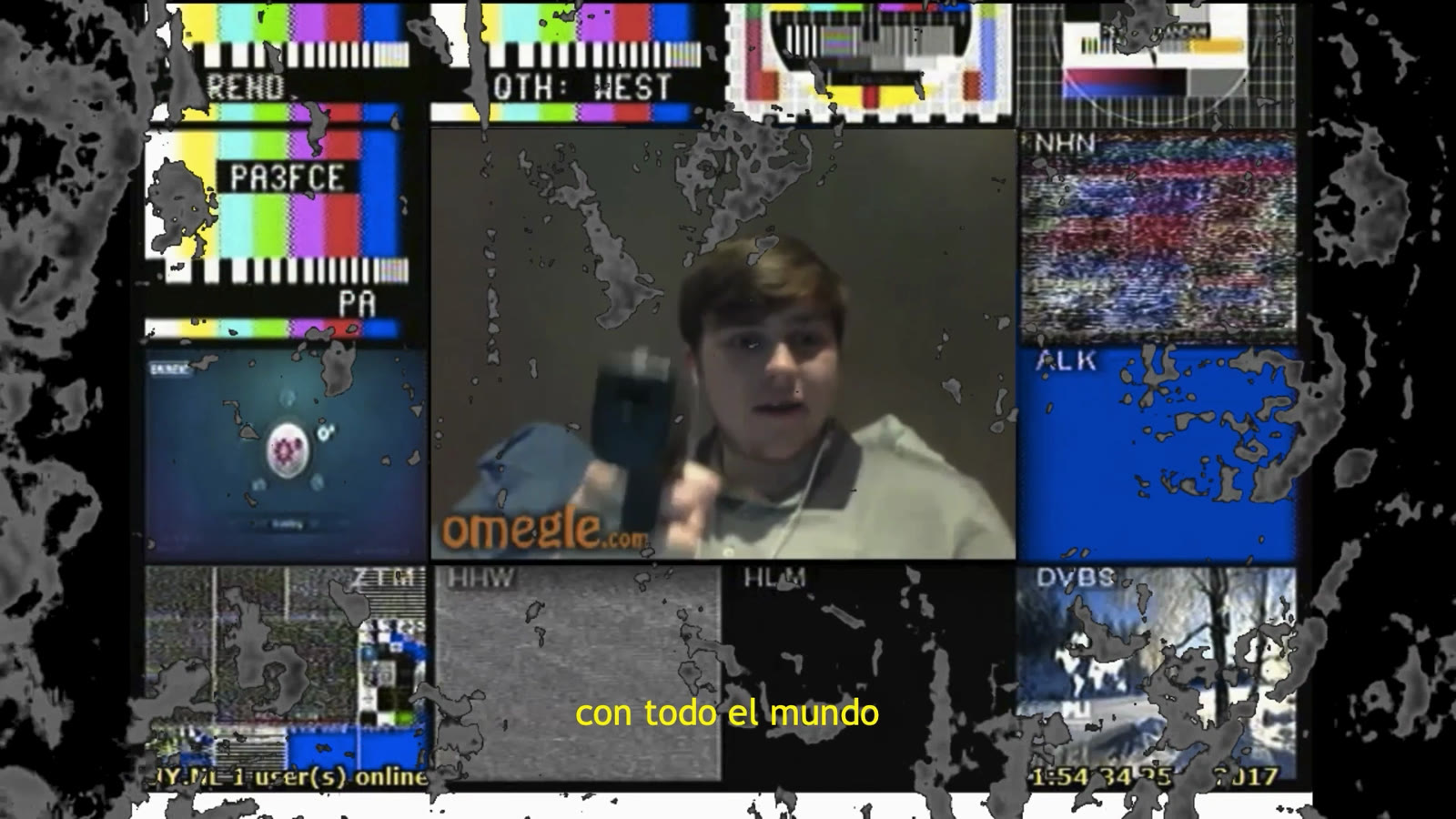
Mijal Melnick works with found digital material, machine vision, and the politics of images that no longer belong to anyone but continue circulating as data. Her video piece Kamarasutras is built from open CCTV cameras, unsecured livestreams, and fragments of digital waste, anchored by the voice of Fátima, a woman living with Xeroderma Pigmentosum.
Could you describe your work featuring in the Prize, and how it sits in relation to your practice more broadly?
Kamarasutras is built from open CCTV cameras, unsecured livestreams, and fragments of digital waste collected online. For this iteration, those constantly shifting operational images are held together by the voice of Fátima, a woman living with Xeroderma Pigmentosum, a condition that prevents her from being exposed to sunlight. Her narration introduces an intimate perspective into a visual world largely produced by machines.
The work revolves around the tension between these two ways of seeing: the detached, automated gaze of surveillance systems and the vulnerability of a body whose relationship to the outside world is mediated by technology.
This piece sits at the core of my practice. I'm interested in what happens when images that were never intended to be seen as art are displaced into an exhibition space. Most of my work deals with found digital material, machine vision, and the politics of images that no longer belong to anyone but continue circulating as data.
What is your relationship to the moving image as a medium; when did it enter your practice, and what does it let you do that other mediums don't?
I didn't come to moving images through filmmaking. I came to them through surveillance, found footage, and online infrastructures.
At some point I realised I wasn't interested in producing new images when the world was already being recorded continuously by machines, mostly for other machines. That completely changed the way I thought about video.
What attracts me to moving images is that they let me work with systems that exist in real time. I can follow interruptions, glitches, compression artefacts, transmission failures, moments when the infrastructure becomes visible. Video also allows me to think of the archive as something active rather than historical, a living system that continues to observe, collect, and circulate information.
Are there artists, filmmakers, or traditions outside of art you feel in dialogue with here?
I feel a strong affinity with Édouard Glissant, particularly his idea of the Right to Opacity. His writing has been important in shaping the way I think about visibility and the assumption that everything should become transparent.
Within contemporary art, I often find myself in conversation with artists like Harun Farocki and Trevor Paglen, whose work has fundamentally changed the way we understand operational images and machine vision.
At the same time, many of my references come from outside the art world altogether. Server architectures, default user interfaces, cybersecurity, spam aesthetics, and the visual language of networked systems all shape the way I think about images. I'm often more interested in the design of infrastructure than in traditional visual culture.
Some people use "experimental" to mean formally unconventional, others to mean something closer to research or inquiry. Which is closer to how you're using video here?
For me, experimental practice is much closer to research than to formal experimentation for its own sake.
Kamarasutras certainly looks unconventional: low-resolution footage, compression artefacts, accumulative editing, but those qualities aren't aesthetic decisions imposed onto the material. They're already present in the images, and I prefer to preserve them rather than clean them up.
I'm using video as a way of asking questions. What happens when operational images, produced without a clear audience or narrative intention, are relocated into an exhibition? Can they still function as evidence? Do they become fiction? Or do they reveal something about the invisible infrastructures that organise contemporary life?
What would you like visitors to experience when spending time with your work?
I don't expect viewers to follow a story or solve a narrative puzzle. The work is meant to be experienced more like a drift.
I hope people spend enough time with it to notice the friction between Fátima's calm, intimate voice and the endless flow of anonymous surveillance footage. Those two layers never fully merge, and that gap is where the work really exists.
More than anything, I'd like visitors to leave questioning the idea that greater visibility automatically produces greater safety. We often accept surveillance as something neutral or protective, but I think its emotional and political consequences are far more complicated.
What has the support from FluxusMuseum made possible, for this piece specifically or for your practice more broadly?
The support from FluxusMuseum allowed me to think of Kamarasutras as something unfinished, in the best sense of the word. Instead of treating it as a completed film, I could approach it as a work that changes with each presentation.
The award gave me the freedom to develop this new iteration through re-editing, almost as a form of self-rewriting, where the work continually reorganises its own material rather than settling into a definitive version.
More broadly, the support has made it possible to continue developing this line of research within an international context and to connect these questions about digital appropriation with wider conversations around infrastructure, technology, and contemporary image culture.
What else are you working on at the moment?
At the moment I'm expanding my practice into curating and exhibition-making. I'm organising an international video art screening at Galería La Fuerza in Santiago, Chile, built around a simple idea: reversing the logic of the white cube.
Instead of projecting works inward, toward the gallery audience, the videos will be rear-projected onto the gallery's windows so they face the street. The images will look directly onto Plaza Italia, the symbolic centre of Santiago and the historic site of protests, celebrations, and collective gatherings.
What interests me is the friction that appears when images usually confined to private screens or online spaces suddenly occupy such a politically charged public site. Rather than presenting video art as something isolated from everyday life, I'm interested in letting it collide with the city and become part of its rhythms, interruptions, and conversations.