
“Walking through a city, we collect how a place affects the body, and how the body responds to that place.”
Now in its third year, the FluxusMuseum Prize for Experimental Video gathers eleven artists and collectives from a field of over 600 international applications, works chosen for their resistance to easy categorisation, their originality, visual rigour, and an uncompromising approach to the form. Installed across the old marble factory by Parikia’s yacht harbour, the exhibition runs until the end of September, with prize winners announced in mid-September. Ahead of the announcement, we catch up with each of the eleven shortlisted artists and collectives.
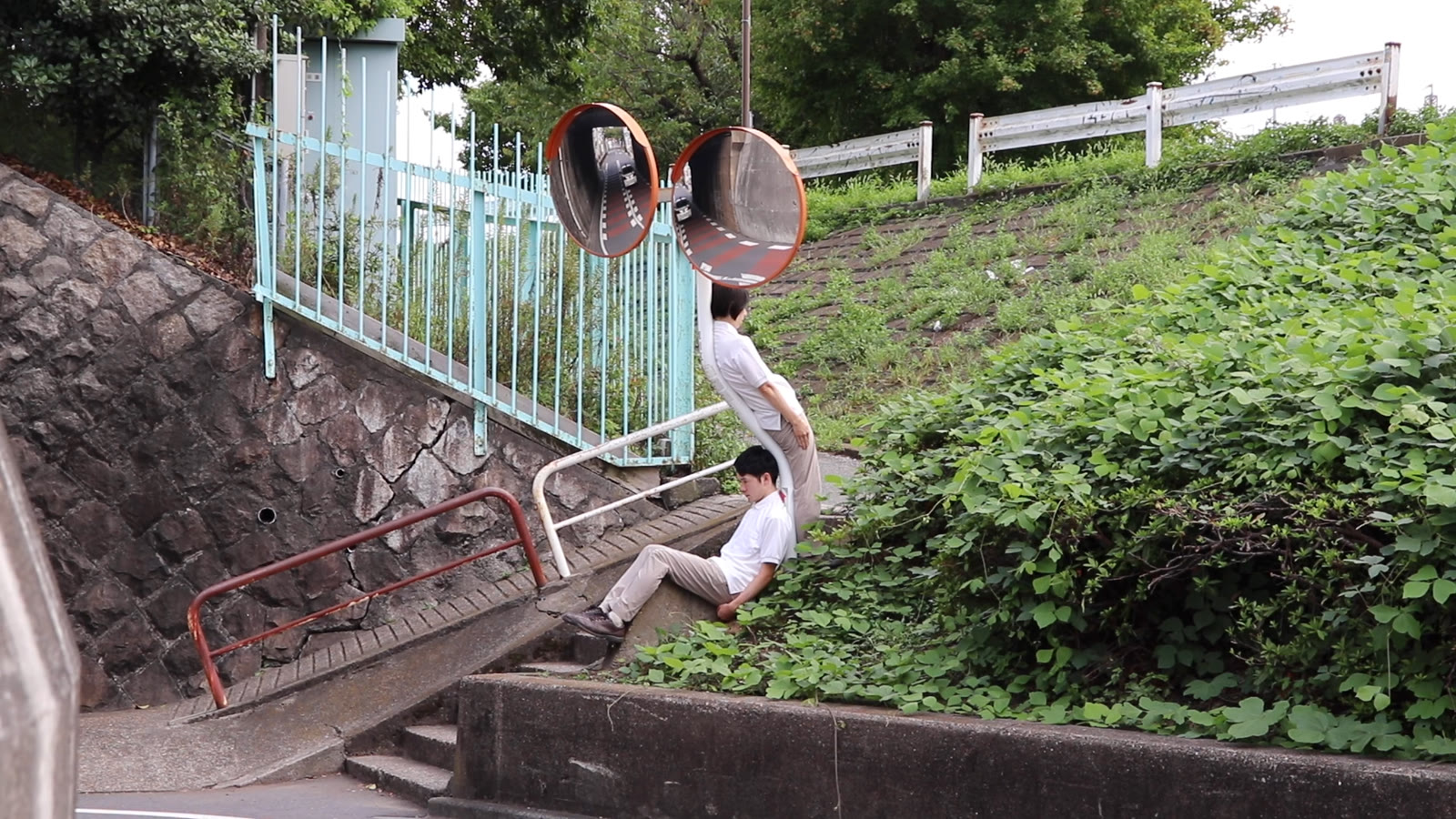
Among this year's shortlisted artists is Aguyoshi, whose dance-on-video practice draws on postmodern dance, Butoh, and the Japanese tradition of roadside observation to trace how bodies and cities shape one another.
Could you describe your work featuring in the Prize, and how it sits in relation to your practice more broadly?
AG: "Movement Within the City" is edited from short videos we've accumulated over the past nine years, selected and assembled especially for this Prize. We kept in mind that the work would be shown on a Greek island, far from Japan. Sequenced together, the fragments took on a new rhythm of their own.
What is your relationship to the moving image as a medium; when did it enter your practice, and what does it let you do that other mediums don't?
AG: As dancers, we've chosen to let go of performing on stage — video entered our practice about nine years ago, when we started this project. By presenting our dance through video instead, we've found that viewers take in the whole landscape, rather than focusing too closely on our bodies alone. This format also lets us bring our local dance to audiences around the world.
Are there artists, filmmakers, or traditions outside of art you feel in dialogue with here?
AG: In dance, we draw on postmodern dance — Trisha Brown and others — as well as Tatsumi Hijikata's Butoh. We're also connected to a Japanese tradition called rojo kansatsu, or 'roadside observation,' which artists like Genpei Akasegawa turned into an art practice in the 1980s. The tradition continues today, with people collecting and observing things like manhole covers, hand-lettered signs, a single glove dropped on the street, or plants grown outside someone's front door. Our work belongs to that same lineage of attention.
Ten years ago, an exhibition by John Wood and Paul Harrison that we saw in Japan left a lasting mark on us — it taught us the value of humour and of meaninglessness. Among our contemporaries, it's encouraging to see the work Charles Auguste and Matt McCreary are sharing through social media.
Some people use "experimental" to mean formally unconventional, others to mean something closer to research or inquiry. Which is closer to how you're using video here?
AG: Both, in a way. To others, our approach might look formally unconventional, simply because it doesn't fit any existing genre. For us, though, it leans more toward research — observation, inquiry. Walking through a city, we collect how a place affects the body, and how the body responds to that place.
What would you like visitors to experience when spending time with your work?
AG: We'd just like people to enjoy it, without overthinking it. If watching our work brings to mind a small staircase near their own home, or an oddly shaped tree they'd never quite noticed before — and if that brings a bit of affection for it — that would make us happy. And if anyone feels like trying it themselves, that's more than welcome too.
What has the support from FluxusMuseum made possible, for this piece specifically or for your practice more broadly?
AG: We're very grateful — there aren't many competitions out there that welcome experimental work like ours. The production support also enabled us to travel to more places than we otherwise could have.
What else are you working on at the moment?
AG: Mostly, we're continuing our research by walking through cities. We'd like to keep doing this for the next forty years.

Aguyoshi is a dance duo founded in Japan in 2016 that explores the city on foot and performs outdoors. Their choreography is shaped by the unique characteristics of each location, making the space itself, rather than the dancers, the main focus. In addition to posting numerous short videos on social media, their activities include facilitating workshops, performing at outdoor festivals and art events, and choreographing and performing for video content and theater. Aguyoshi consists of Aisa Shirai and KEKE, who are based in the Greater Tokyo Area.